I'm sure I've mentioned on here before that I'm at a non-parish based internship site. I think this makes me the only ELCA intern who is not formally attached to a congregation. When I knew that I was coming to Pine Ridge, I will admit that I was a tad worried that I wouldn't have worship opportunities.
It has been QUITE the opposite.
In addition to all of the daily programming that we do with retreat groups and community members, we host worship for the children two nights a week. The kids are here every night, but the other nights are only for "safe play." In addition to this, we lead worship services at St. John's Episcopal Church twice a month and Cohen Home, an assisted living facility, twice a month as well. Then, we plug in wherever we can assist in other communities.
Tomorrow, I'll be preaching/leading the service at Makasan Presbyterian Church in the morning, St. John's Episcopal Church in the afternoon and Cohen Home in the evening. As I sat at my desk this morning putting together the three services, I just started to laugh.
Here's the pile of resources that I used and will use for tomorrow's services:
The black binder is the worship binder that I've created to hold all of our various services. Then, my Harper Collins Study Bible, complete with my scribbled margin notes of profound thoughts by the great Ralph Klein, the Evangelical Lutheran Worship hymnal, the With One Voice hymnal, the Lakota Presbyterian hymnal--Dakota Odowan, the Episcopalian Lakota hymnal--Wakan Cekiye Odowan and the Book of Common Prayer.
Not pictured: my sermon manuscript, past worship plans for the various services, Bible commentaries and the Internet.
All of the items in that picture will go with me to these services tomorrow as I move from congregation to congregation and from denomination to denomination. While I'm not at a "parish-based internship site," I think I'm getting my share of worship planning and leading, as well as preaching. And hey, what other ELCA Intern can immediately find the various services in the Book of Common Prayer and sing the Doxology in Lakota?
I would like to reach out my hand. I may see you, I may tell you to run. You know what they say about the young. Well pick me up with golden hands. I may see you, I may tell you to run. You know what they say about the young. Well I would like to hold my little hand. How we will run? We will. How we will crawl? We will. Send me on my way, on my way
Saturday, February 2, 2013
Sunday, January 27, 2013
Culture and Foster Care
Basically, the article discusses the disproportionate number of Indian children in foster care and the struggle between cultural ties and a safe, healthy home. In Montana, only 9 percent of the entire state's population is children who are Indian, but they represent 37% of the children in foster care. The Indian Child Welfare Act of 1978 requires that children be placed with Indian families whenever possible, which also means that the tribes have a say in the custody cases. The difficulty now is that there aren't that many Indian foster homes. "In Bernalillo County, for instance, there are 65 Indian children in state custody but only 5 Indian foster homes, prompting Gov. Susana Martinez to publicly appeal for more families last March."
As I live and work in a Lakota community, I am keenly aware of how important culture is to any race or ethnicity of people, but most especially to a race and ethnicity of people who are being slowly exterminated.
I love to talk about culture and heritage. I'm quite proud of my Irish ancestors or even the Czech ones. I wear a Claddagh ring that my mom bought me in the town that my great grandparents lived, Westport, County Mayo, Ireland. I loved being in a place where I saw my family's features all around us in the noses, hair, eyes, etc. As much as I love to claim that being a quarter Irish is significant to me, I'm not culturally Irish. I don't know any Gaelic. I don't know how to step-dance. I don't really eat any Irish food, other than absurd amounts of mashed potatoes at every holiday gathering. But the thing is, Irish culture isn't disappearing with each generation. Yes, there are a few less Gaelic speakers, but the culture as a whole is still intact.
Thinking about what it would mean for an Indian child to live with a non-Indian foster family would be incredibly detrimental to their development as an Indian person. Yes, the child would miss out on Pow-Wows and wouldn't learn any Lakota, but the child also wouldn't learn about kinship, which is the way that family matters above all else. I can tell you that my mom, sister and brother matter above all else, but it's different in Indian culture. No one seems to question skipping work or cancelling any responsibilities--church services, meetings, etc--if someone dies. Everyone goes to the funeral, because that's where you need to be.
The family structure here is key for survival and for culture. Traditionally, families would send their oldest child to live with their grandparents. I haven't quite caught on if there was intentional motive for either side in this, but it was tradition. You can still tell the adults who were the oldest child in their families, because they speak the most Lakota and seem to embody the strongest Lakota virtues.
Due to my experience here, I support this act and its desire to place children in homes where their culture is not only preserved, but nourished. I don't doubt that non-Indian parents can do their best to encourage the child to remain in close-contact with the tribe, but it is different. I have a friend who was adopted from another country as an infant by Euro-American parents. She has been raised by them and loves them dearly; she's also realizing how many questions she has about her biological parents and the culture that she came from. She referenced this feeling of being an outsider everywhere she goes, because she's not "quite" any particular race. This is an example of adoption as an infant, which is different than a 13 year-old being in foster care. I lift it up as an example of how multiple cultures can pull at you and cause significant struggle in establishing an individual identity within a larger group.
The title of this article is:
Focus on Preserving Heritage Can Limit Foster Care for Indians
I read the title when I started the article and re-read it when I finished the article. I don't think the title represents the feeling that I have when I finished reading it. The title implies that the hope in preserving heritage takes away possibilities for life with a foster family. We're denying that work could be done to strengthen families through different support systems in the tribes. We could also encourage more Indian families to consider fostering and adopting children.
I ask that you keep all children in your prayers this day, especially children living in unsafe situations all over the world, regardless of race, ethnicity, socio-economic status, sexual identity and ability.
Saturday, January 26, 2013
"To love another person is to see the face of God."
On Sunday, after not having morning worship due to mud, I decided to head to Chadron to see a movie. I debated my whole drive there whether I'd rather see Les Miserables or Django Unchained. I figured Les Mis would be better on the big screen, but I was really curious about Django. I made a quick decision when I walked into the theater for Les Mis and paid a whole $4.50 for the show. There are some perks to living in the middle of nowhere. I don't think you can even Redbox a movie in Chicago for $4.50! Kidding. Yes, you can.
Anywho.
I took my seat in the theater, which is an incredibly liberating experience. I love making my own decisions sometimes, without any thought as to anyone else's needs. I don't mean this to be selfish, but so much of my internship is spent thinking through how my actions will affect my supervisor, my co-workers, the kids, the congregation members, the community members, my internship committee, my candidacy committee, my seminary advisor/faculty members, my friends, my family, etc, etc. Needless to say, I do a lot of mental work with others' needs in mind. Walking into a theater and picking the seat that best suits me in that precise moment, not to mention only needing one seat instead of multiple, is quite enjoyable.
I settled in for the singing and dancing of Les Mis. I've read the book and I know most of the songs, but I've never seen the show. About halfway through the movie, I realized that the woman closest to me was sobbing. I wasn't feeling the emotions of the movie quite as she was, so it caught me off guard. I began to think about this during one of Russell Crowe's less-than-enjoyable singing expeditions (I wasn't impressed).
I figured out that this felt silly to me. I live in a place where death and struggle exists every day. I can't remember if I wrote this before, but one of the schools in the area didn't have school for the first three weeks of January because there were so many funerals that needed to happen. Last week, there were five funerals in the area on one day. Five.
Seeing Ann Hathaway crying? Doesn't quite hit me like life here does. Call me bitter or jaded, but it's the truth.
At the very end of the film, I heard one of the singers say, "To love another person is to see the face of God." And that, my friends, was the Good News of the day. Seeing God in every person that I encounter is sometimes difficult, but so is loving them. Let's be honest here. There's all that stuff in the Bible about "loving one another" because Jesus knew how incredibly hard it was--check out his story of persecution! This woman was crying because some part of her was moved by the story of the peasants suffering in France; I wasn't crying because I feel a little cried-out right now of the suffering here. I think that's how God feels. God cries at the pain and suffering; God also feels numb and exhausted by the amount of pain and suffering in our world. When we look into each others' eyes, seeing each person as a human being and loving one another as God does, then we see what God's face looks like. Good, bad, happy, sad, excited and so forth.
And so, we keep going, one more day, to see what the face of God looks like as we love one another.
Sunday, January 20, 2013
Rural Ministry: Mud
I've talked before on here about how we're beyond rural ministry; we're doing frontier ministry. I'm serious when I say this, since life in ministry here is a bit different than my friends who are doing internship at urban, suburban or even small-town parishes. I was hit with it this morning when I received a message from my supervisor saying that the service at the Episcopal congregation that we work with has been cancelled. Why would you cancel a worship service in January, you ask?
Not snow.
Not ice.
Not rain.
Wait for it....mud. Yep, mud. It's too muddy to get the cars in and out of the driveway. Around here, folks call the mud "gumbo." One of our recent retreat guests found it distressing that we would call mud gumbo, since gumbo is good and tasty. I don't think you should think too much about the exact dimensions of gumbo compared to the red, rocky mud that fills our parking lots and driveways here. Instead, think about trying to walk or drive in gumbo. You'd probably lose a shoe, much like my supervisor almost did yesterday in someone's driveway. The mud is just that thick, folks.
Since I love to preach and a cancellation due to mud means no preaching this morning, I'd like to share my sermon. In some ways, I don't believe that it's a full sermon, since sermons are partly, if not mostly, in the delivery. Regardless, here was the sermon scheduled for today:
John 2:1-11: St. John’s Episcopal,
Cohen Home
January 20, 2013
This is a fascinating
story. We hear about lots of miracles in
Jesus’ time: healing, exorcisms, feeding large crowds, and so forth. But, here in John’s gospel, these aren’t
“miracles.” They are signs. Signs of who Jesus is and what Jesus is
capable of. These signs show us, thus eliminating
doubt in the awesomeness of Christ’s life and teachings. I should also add that this particular sign,
the one of turning water into wine, is only shared in the Gospel of John. And this is the first of his many signs.
Jesus is a guest at this wedding, not the host, and his mother, who is never actually named in the Gospel of John, comes to tell him that the party is out of wine! What exactly did she expect Jesus to do? This is the first of many signs, so how does she know what he’s capable of? He responds, “Woman, what concern is that to you and to me? My hour has not yet come.”
Woman, my hour has not yet come.
Jesus doesn’t respond to his mother with the whiney tone of a teenaged boy, telling her that he’s not ready for dinner or to do his homework. He’s not playing a video game or basketball. In the story we hear, Jesus is not doing anything else that could prevent him from fixing this wine issue that his mother is concerned about. Instead, he tells her that it’s not the time.
Jesus said to them,
“Fill the jars with water.” And then,
when the waiters served the beverage out of the jugs, it was wine. And not any old wine, but good wine. Tasty wine.
The type of wine that you’d save for the finest of guests. This wine wasn’t saved though. It was created out of water. The simplest of drinks, the liquid which
nourishes our thirsty bodies after a hard day’s work, was transformed into the
festive drink with layers of scent and flavor.
Jesus’ time has not come, but he has put into place the first of many
signs showing the way that even the simplest of substances can be transformed
into something extraordinary.
And this, my friends,
is still not the hour that Jesus is referencing. Yes, the time had come to transform the water
into wine, but the bigger transformation was yet to come. The hour was not at hand. The hour of the ultimate transformation was
not until much later in Jesus’ teaching and ministry. The hour was after the wine, after the
crowds, after raising Lazarus from the dead, after being crucified for all to
witness his death. The hour was when
Jesus rose from the dead and showed us the greatest sign of transformation:
triumph over death.
Woman, my hour has not yet come.
The mother of Jesus must wait during this wedding feast atCana
and throughout Jesus’s life for the right time.
She comes back at HIS hour, the hour that Christ has prophesied about in
this sign of converting the water into wine, and she finds herself at the foot
of the cross, witnessing the transformation of her precious baby boy into the
Savior of the world.
Woman, my hour has not yet come.
The mother of Jesus must wait during this wedding feast at
Woman, here is your
son.
When Jesus addresses his mother later in the Crucifixion story, Jesus also addresses each one of us: Here is your mother. Here is the mother of our Lord and Savior. Here is the young woman, scared about birthing God’s child into the world, transformed to being the mother of the one who performs signs. Here is the mother of the one who is to turn the world upside down and inside out, changing us out of water and into wine.
The transformation
from water into wine, death into life, bad into good, is the essence of Jesus
Christ. We are empty vessels, capable of
being filled and transformed, sanctified and brought into a newness of
life. We sit, waiting, hoping, looking
forward to the next step, just like the mother of Jesus sat and tried to
encourage him.
And, sometimes in
waiting for this transformation, I get a little bit antsy, just like her. I ask myself, “When???” or “Why?” or
“How?” I want to know how it’s all going
to play out.
Lots of people have introduced themselves to me in my time here and have said, “I’ve been
sober for 23 years” or
10 years or 5 years or 27 days, and often, that declaration of sobriety has
come with a strong conviction of faith in God, faith in Jesus Christ, faith in
the way that God can transform us, even when we have deemed ourselves unworthy
and incapable of being reformed.
The mother of Jesus
was worried that the party would run out of wine, yes, but she was likely more
concerned that Jesus was missing an opportunity to make a difference. Like any good mother, she had high hopes for
her baby boy. As we know, this
conversion was the first of many signs, of many good signs, showing the power
of transformation.
There were six stone water jars, each holding twenty to thirty gallons of water for purification. Anywhere from 120 to 180 gallons of water turned into wine, without so much as a magic trick or a hand blessing. Jesus simply said to fill the jugs with water. Then, when the “water” was served, it was wine.
Jesus tells us how to fill ourselves with water, with what appears to be a simple act: Love one another as I have loved you. For with you, O God, is the fountain of life; in your light, we see light. God has created us as the clay jugs, preparing to be filled by the simple gifts of life and transformed into divine creatures.
How are you being filled by God? How are you being transformed? No, really, ask yourself these questions.
There is no shortage
of good wine with Jesus. 120-180 gallons
of water into wine? That’s an awful lot
of wine. And frankly, I believe that had
there been 12 jugs, Jesus would have filled those. 18? Not
a problem. 120? Done. See, there is not shortage of wine, but
really, there is not shortage of the power of transformation through life with
Christ. God is abundance. Even when we think that we are incapable of
being changed, unworthy of being transformed, God meets us in those moments of
emptiness, fills us with the power of a God who loves us so much that he gave
his life for us, and we then are the good wine. God’s love is abundant, overflowing for all to
experience the sweet taste and smell of, while basking in the glory of the
community gathered around to celebrate this miraculous transformation. How precious is your steadfast love, O
God! Amen.
Friday, January 18, 2013
Thursday, January 18, 2013
Today was an odd day. Kinda rough, actually. I hesitate to write about it, since I don't want to write an entirely negative representation of life here. I need to be honest in sharing my stories of life here though and this is what today held. To be fair, I firmly believe that these experiences could have happened anywhere.
My morning started off by leaving my apartment to let Steve out. I noticed a man at the kitchen table who I didn't recognize. When I came back inside and sat down for breakfast, I had no idea who he was and nobody introduced him to me. As someone who was a social worker for awhile and as the child of a social worker, I have a pretty good sense about people. Something didn't click right for me with this visitor. He seemed to talk in circles and said some pretty harsh things. At one point, he said that Jesus lost his salvation when the people killed him and that we lose our salvation when we do bad things. I listened patiently, then interjected that I don't believe Christ or we lose our salvation because nothing can separate us from God. He seemed slightly appeased by this idea, but quickly moved onto his set of statements. There were some other odd details about his story, but I'm not going to share those in such a public way.
My morning continued when my supervisor and I were invited to "do prayers" for a "fetal demise." I was just talking with Karen yesterday about the different language surrounding fetal death: stillborn, remains of conception, etc. I struggle with how to appropriately gauge what language to use based on the family's needs. Some parents consider the fetus a child and a part of their family from the moment of conception. Others seem to disregard it, preferring to designate it as remains. When we headed to the hospital this morning, we really had no idea how far along the mother had been or what the story was.
Upon arriving at the hospital, I saw a man who had built himself a little cave in a pile of snow and was sleeping in it. I've seen plenty of people who are sleeping on the sidewalk, park benches or public transit before, but seeing a man who had found the most protection and warmth out of sleeping in a pile of snow was a new one for me.
We visited with the mother who asked for our prayers. We went through the Evangelical Lutheran Worship Pastoral Care book's service to commend an unborn child to God. We prayed for her and sang "Precious Lord, Take My Hand" when she asked for it. After going through most of the prayers and readings, a nurse came in with a plastic bin and what appeared to be some fabric in it. I assumed the nurse was ready to do some sort of bath with the mother. Eventually, the nurse joined us on our side of the room, holding the fabric in the bin and handed it to the mother. The fabric bundle was actually the child that wasn't living. The mother held her lifeless child and said that had the little girl made it eight more days, she could have lived. Eight days. Eight days stood between this perfectly formed, but very, very small infant, and life. Sure, being born would have meant some time in the NICU and lots of medical care, but she would have been born. She would have grown into a baby, a toddler, a child, a teenager and eventually, she would become an adult.
I completed my Clinical Pastoral Education (CPE) at a great community hospital in North Carolina. Spending the summer as a hospital chaplain was interesting. I didn't have a lot of trauma cases, since I was assigned to a medical floor and to an outpatient rehab section. Part of me wanted to have the Obstetrics ward or the Emergency Room, just to experience the "bigger" cases. Of course I say that and I'm pretty sure that I was a part of the most deaths of my CPE group--not fun. I returned to LSTC feeling challenged and changed by my CPE experience, but always questioning if I had experienced everything.
Today, after doing prayers and trying to provide words of comfort, the mother held out her baby to us and asked if we wanted to hold her. I've never felt so simultaneously honored and horrified at the same time. I was a stranger, a nobody to her, and I was about to hold this child that never took a breath? Who the heck am I?
Then, on top of all of this, my head is spinning around the fact that my precious godson Henry was in the NICU for the first month of his life. He could have been born eight days too early.
I held that precious baby and focused on the moment with the mother, but my head feels incredibly heavy right now.
My supervisor stepped out of the room to get the nurse at one point and the mother said, "It's really hard to be here [in the OB ward] and hear all the other babies crying." I spent nearly a week holding Henry and hearing him cry, not realizing how painful a baby's cry could be to a parent who's body is convulsing in pain from the greatest grief that I think one can experience.
The day went on to hold some weird and some hard experiences. People keep asking me how internship is going. I generally say that it's good, but difficult. I wish that I could just show you the images in my brain of the hard stuff.
Wednesday, January 16, 2013
Baptism: Sanctifying the mundane
| How could you NOT fall in love with this little guy? |
Katie was especially sad that we were all going to be out on internship when the baby was born, so I said that I would try to come back and visit.
Well, I love Katie and Zak...and I love traveling...and I couldn't even IMAGINE missing the opportunity to meet little Henry Christian Wagner as a baby. So, I bought my plane tickets. At some point in the fall during a conversation with Katie, she asked me if I would be Henry's godmother. My heart nearly stopped. I started to tear up and got SO excited to support Henry in his faith journey. Needless to say, I've been planning for January 6th, the day Henry was baptized, for months.
I arrived in Chicago on January 4th, giving myself plenty of time in case weather would affect my trip. I spent the 4th through the 9th with Zak and Katie, falling absolutely in love with my godson. On the night of the 5th, the night before his baptism, Katie asked if I wanted to help bathe Henry. As I watched Katie gingerly place this four-month old angel into his bath tub, I started to feel the emotions churn. Katie looked into Henry's eyes as she wiped him clean, smiling at him and he smiled at her. I felt like I was witnessing one of the most sacred moments in my life. For Katie, it's a regular occurrence to bathe her baby, but for me, I felt this palpable love exchanged between mother and child. I kept the tears in, but it was a struggle to keep it together.
The next morning, I stood with Zak's brother Jake, Henry's godfather, and promised God, the Church, and Henry, that I would support him in his faith journey. It was the absolute COOLEST thing that I have ever done!!! I've been all over the world. I've been skydiving. I've snorkeled in the Caribbean. I've gone scuba diving in the Red Sea. I've climbed into a pyramid and I've sat at the top of the ski jump in Lillehammer. I have done awesome things. Really. None of these things are nearly as awesome as promising to love and support Henry for my lifetime.
Now, you may start to be asking yourself why you're reading this. Let's be honest--does it matter to you who my godson is? No. Not really. I write all of this to share what being a Christian is about for me.
The sacraments of the ELCA: Eucharist and baptism, are both mundane, regular tasks. Eating and bathing. Sure, we all eat different things and clean ourselves in different ways, but we all do it. Standing in a large congregation, surrounded by six hundred people worshiping on a Sunday morning didn't make the act of baptism any more sacred for me than the bath that Katie gave Henry the night before. God is in both of those acts. God is the parent's love, gazing into our eyes and loving us from before we were even formed in the womb. God is the godparents' love, committing to raise us up in God's house, walking beside us in our journey. God is the community's love, supporting and celebrating with us.
And that, my friends, is pretty stinkin' cool.
Christmas!
| The bag making team! |
| Some of Santa's workshop |
| Not about where you're at, but who you're with! |
When I signed up for seminary, I really didn't think about what it meant for my family--sorry, y'all. But to see them in South Dakota, ready to hear me preach the Gospel, the good news, while stumbling through the Lakota hymns and wondering what the heck they had signed up for, was an awesome gift. I am so blessed and honored to have them in my life. :)
| Taking the traditional family on Christmas Eve in a less than traditional spot. |
Magnificat
I've got the time, so this will be a pile-up of blog posts. Get ready!
Every month, we gather together with the pastors and leaders of our conference. I look forward to each one of these gatherings, because it's incredibly refreshing to move quickly in our conversations from the weather to the theological implication of preaching the crucifixion on Christmas Eve to ecumenical youth trips to the best Thai food in Rapid City. In December, we met in Bellefourche, South Dakota, and did Holden Evening Prayer...in the morning. The pastor leading the devotion asked me if I thought I could say something with a loud voice.
Hah. Clearly, he doesn't know me that well. I've been asked, on more than one occasion, to use my "inside voice" by my family. Needless to say, I was up for the gig.
As he was reading from the Gospel of Luke, the first chapter, verses 39 to 55, it was my job to start this sound-off of women. He read, "41When Elizabeth heard Mary’s greeting, the child lept in her womb. And Elizabeth was filled with the Holy Spirit 42and exclaimed with a loud cry, ‘Blessed are you among women, and blessed is the fruit of your womb." I spoke loudly from my seat in the pew, "Blessed are you among women, and blessed is the fruit of your womb." Then, another woman spoke it. And another. And another. In total, approximately six women repeated the line. It was haunting to hear the the different voices repeat the blessing from the pews.
With each voice, the line hit me harder each time. I'm not a mother. I don't know what it's like to have a child in my womb leaping for joy when someone else comes in to visit. In fact, this just sounds alien and a bit creepy to me. I never know where to place myself in the Christmas narrative as Mary is preparing herself to carry the Christ-child. Hearing the different women say this line, some who are mothers and some who are not, pushed me to realize that our "wombs" are not only the reproductive organs in a female body. We all have wombs. We are wombs.
Alright, Mer, you're talking crazy stuff now. No, seriously. This blessing is for all of us--all sexes and all positions in life. Our bodies, including our minds and spirits, are to produce fruit for God. For some, that's the act of bringing a child into the world and raising her to be a faith-filled leader in the Church. For others, it's serving the community around them as the best dentist that he can be or the faithful accountant. We, as created children of God, are blessed by our own lives and are given the ability to create life and goodness out of our own works. And that is blessed in God's sight as well.
I don't know that I have any good pictures to describe this, but I challenge you to think of yourself as a womb, capable of nurturing good in the world. Peace be with you, friends.
Historical Events
December was rather busy and I'll blog some more about those happenings, but I want to take some time to talk about the significance of December for the Lakota people.
December 26, 1862: Mass hanging at Mankato, the largest mass hanging in US history
I've read several articles about this to try to have a thorough way of presenting what happened in this instance. Sadly, I can't. What it seems to come down to is that Lincoln ordered the execution of 38 Indians to make his political allies happy and to further eliminate the Native peoples. Maybe, I can't find a nice way of talking about all of this because I was born and raised in the United States, learning about the great work that Abraham Lincoln did in emanicipating the people who were enslaved in the United States. I've always preferred Lincoln to some of the other historical figures. Honest Abe, right? He's a good guy, right? We've got his face on Mount Rushmore because as the Mount Rushmore museum and displays says something along the lines of 'The faces of the men chosen for this monument are the faces of those that represent life, liberty and freedom for all.'
Wait, life, liberty and freedom for all? Was Lincoln supporting life, liberty and freedom for the 38 men who he ordered to be slaughtered in a town square to eliminate the Indians in Minnesota? Not to mention that these men were buried in a mass grave, after some of their skin was cut off and sold (http://www.cr.nps.gov/nagpra/fed_notices/nagpradir/nic0342.html).
As you likely know by now, I could go off on rants about the injustice of the US government to the Native people for days. I present this information to you as a starting point to learn more about the nation that you call home and the history that you have been taught.
Here are some more sites with interesting articles. They may not be credible or academic, but here's what I've found:
http://www.unitednativeamerica.com/hanging.html
http://law2.umkc.edu/faculty/projects/ftrials/dakota/dakota.html
http://minnesota.publicradio.org/display/web/2010/12/22/dakota-conflict
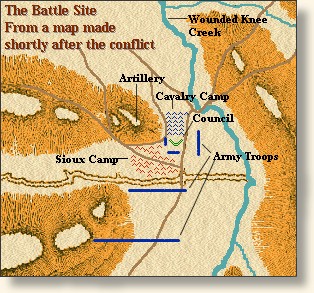
December 29, 1890: Massacre at Wounded Knee
I'd love to write some eloquent version of this story, but I'd rather quote it from someone who has already described it.
The once proud Sioux found their free-roaming life destroyed, the buffalo gone, themselves confined to reservations dependent on Indian Agents for their existence. In a desperate attempt to return to the days of their glory, many sought salvation in a new mysticism preached by a Paiute shaman called Wovoka. Emissaries from
the Sioux in South Dakota traveled to Nevada to hear his words. Wovoka called himself the Messiah and prophesied that the dead would soon join the living in a world in which the Indians could live in the old way surrounded by plentiful game. A tidal wave of new soil would cover the earth, bury the whites, and restore the prairie. To hasten the event, the Indians were to dance the Ghost Dance. Many dancers wore brightly colored shirts emblazoned with images of eagles and buffaloes. These "Ghost Shirts" they believed would protect them from the bluecoats' bullets. During the fall of 1890, the Ghost Dance spread through the Sioux villages of the Dakota reservations, revitalizing the Indians and bringing fear to the whites. A desperate Indian Agent at Pine Ridge wired his superiors in Washington, "Indians are dancing in the snow and are wild and crazy....We need protection and we need it now. The leaders should be arrested and confined at some military post until the matter is quieted, and this should be done now." The order went out to arrest Chief Sitting Bull at the Standing Rock Reservation. Sitting Bull was killed in the attempt on December 15. Chief Big Foot was next on the list.
**This information comes from http://www.eyewitnesstohistory.com/knee.htm
The Massacre at Wounded Knee is a very real part of everyday life here on Pine Ridge. We take all of our retreat groups to visit the mass grave and pay their respects to the deceased. There's something haunting about walking around a mass grave, knowing how many lives were ended because of racism and misunderstanding about who people are. The grave is a patch of grass surrounded by a small sidewalk on the perimeter, then a chain link fence. I've been to other grave sites where there's lots of concrete or structures to mark the grave, which seem to take away the rawness of what this massacre meant. When I stand on the sidewalk, looking at the maybe four foot by twenty foot grave, I stand in the same spot where people threw the deceased, frozen from the cold, into this pit.
It's also important to mention that often the Massacre at Wounded Knee is called the Battle at Wounded Knee. Prior to coming out to Pine Ridge, I watched a documentary discussing the native presence in the Chicago area and the history there. One historian said, "If the Indians killed the white men, we call it a massacre. If the white men killed the Indians, we call it a battle." We, as people of 2012, do have power to choose how we acknowledge the history of peoples all over the world. My plea for you, as my readers, is to consider the language of how we tell the stories of our history.
More information can be found at this great site that my mom found: http://www.woundedkneemuseum.org/main_menu.html
December 26, 1862: Mass hanging at Mankato, the largest mass hanging in US history
I've read several articles about this to try to have a thorough way of presenting what happened in this instance. Sadly, I can't. What it seems to come down to is that Lincoln ordered the execution of 38 Indians to make his political allies happy and to further eliminate the Native peoples. Maybe, I can't find a nice way of talking about all of this because I was born and raised in the United States, learning about the great work that Abraham Lincoln did in emanicipating the people who were enslaved in the United States. I've always preferred Lincoln to some of the other historical figures. Honest Abe, right? He's a good guy, right? We've got his face on Mount Rushmore because as the Mount Rushmore museum and displays says something along the lines of 'The faces of the men chosen for this monument are the faces of those that represent life, liberty and freedom for all.'
Wait, life, liberty and freedom for all? Was Lincoln supporting life, liberty and freedom for the 38 men who he ordered to be slaughtered in a town square to eliminate the Indians in Minnesota? Not to mention that these men were buried in a mass grave, after some of their skin was cut off and sold (http://www.cr.nps.gov/nagpra/fed_notices/nagpradir/nic0342.html).
As you likely know by now, I could go off on rants about the injustice of the US government to the Native people for days. I present this information to you as a starting point to learn more about the nation that you call home and the history that you have been taught.
Here are some more sites with interesting articles. They may not be credible or academic, but here's what I've found:
http://www.unitednativeamerica.com/hanging.html
http://law2.umkc.edu/faculty/projects/ftrials/dakota/dakota.html
http://minnesota.publicradio.org/display/web/2010/12/22/dakota-conflict
December 29, 1890: Massacre at Wounded Knee
I'd love to write some eloquent version of this story, but I'd rather quote it from someone who has already described it.
On the morning of December 29, 1890, the Sioux chief Big Foot and some 350 of his followers camped on the banks of Wounded Knee creek. Surrounding their camp was a force of U.S. troops charged with the responsibility of arresting Big Foot and disarming his warriors. The scene was tense. Trouble had been brewing for months.
The hope of
the Ghost Dance |
the Sioux in South Dakota traveled to Nevada to hear his words. Wovoka called himself the Messiah and prophesied that the dead would soon join the living in a world in which the Indians could live in the old way surrounded by plentiful game. A tidal wave of new soil would cover the earth, bury the whites, and restore the prairie. To hasten the event, the Indians were to dance the Ghost Dance. Many dancers wore brightly colored shirts emblazoned with images of eagles and buffaloes. These "Ghost Shirts" they believed would protect them from the bluecoats' bullets. During the fall of 1890, the Ghost Dance spread through the Sioux villages of the Dakota reservations, revitalizing the Indians and bringing fear to the whites. A desperate Indian Agent at Pine Ridge wired his superiors in Washington, "Indians are dancing in the snow and are wild and crazy....We need protection and we need it now. The leaders should be arrested and confined at some military post until the matter is quieted, and this should be done now." The order went out to arrest Chief Sitting Bull at the Standing Rock Reservation. Sitting Bull was killed in the attempt on December 15. Chief Big Foot was next on the list.
When he heard of Sitting Bull's death, Big Foot led his people south to seek protection at the Pine Ridge Reservation. The army intercepted the band on December 28 and brought them to the edge of the Wounded Knee to camp. The next morning the chief, racked with pneumonia and dying, sat among his warriors and powwowed with the army officers. Suddenly the sound of a shot pierced the early morning gloom. Within seconds the charged atmosphere erupted as Indian braves scurried to retrieve their discarded rifles and troopers fired volley after volley into the Sioux camp. From the heights above, the army's Hotchkiss guns raked the Indian teepees with grapeshot. Clouds of gun smoke filled the air as men, women and children scrambled for their lives. Many ran for a ravine next to the camp only to be cut down in a withering cross fire.
When the smoke cleared and the shooting stopped, approximately 300 Sioux were dead, Big Foot among them. Twenty-five soldiers lost their lives. As the remaining troopers began the grim task of removing the dead, a blizzard swept in from the North. A few days later they returned to complete the job. Scattered fighting continued, but the massacre at Wounded Knee effectively squelched the Ghost Dance movement and ended the Indian Wars.
**This information comes from http://www.eyewitnesstohistory.com/knee.htm
The Massacre at Wounded Knee is a very real part of everyday life here on Pine Ridge. We take all of our retreat groups to visit the mass grave and pay their respects to the deceased. There's something haunting about walking around a mass grave, knowing how many lives were ended because of racism and misunderstanding about who people are. The grave is a patch of grass surrounded by a small sidewalk on the perimeter, then a chain link fence. I've been to other grave sites where there's lots of concrete or structures to mark the grave, which seem to take away the rawness of what this massacre meant. When I stand on the sidewalk, looking at the maybe four foot by twenty foot grave, I stand in the same spot where people threw the deceased, frozen from the cold, into this pit.
It's also important to mention that often the Massacre at Wounded Knee is called the Battle at Wounded Knee. Prior to coming out to Pine Ridge, I watched a documentary discussing the native presence in the Chicago area and the history there. One historian said, "If the Indians killed the white men, we call it a massacre. If the white men killed the Indians, we call it a battle." We, as people of 2012, do have power to choose how we acknowledge the history of peoples all over the world. My plea for you, as my readers, is to consider the language of how we tell the stories of our history.
More information can be found at this great site that my mom found: http://www.woundedkneemuseum.org/main_menu.html
Friday, December 14, 2012
Interview with the....Peter.
| Current view of the front porch of our building and the parking lot...snow! |
My friend Peter sent me an email this morning asking me a couple of questions about life here, so I thought I'd share my answers with you all. They seem like questions that many of you would ask. Peter asked me to blog about another topic, comparing my experiences of living in Occupied Palestine to living on the Pine Ridge Indian Reservation, and I'm still working that one out in my head. So, here you go, Peter!
How's life on the rez?
Life on the rez is good. Things are feeling better these days. I don't know if I've finally adjusted more or stopped resisting the move...or what, but life feels a bit more normal. I had a rough couple of weeks where I felt really out of sorts and like I wasn't "clicking" here. I should add that I am hyper self-aware, so I was still happy to be here and doing my work well, but I didn't feel as in-sync as I would have liked. I told my friend Vance the other day that since the last three months have shown me a lot of negatives, I'm hoping to pick up on more positives. We went to a Christmas program yesterday where I watched some of our young people perform different songs, including Jingle Bells in Lakota. Awesome, right??!!
Is rez politically correct?I'm not sure. People here use it a lot. One of the pastors in town wrote a book called "Rez Ramblings." So, I guess people use it. Someone told me recently that I have a "rez car." A lot of the cars around town are missing windows, including the front windshield, or seem to be held together by tape and bungee cords. "Rez car" doesn't sound like a compliment. Though, there are plenty of really nice cars around town--brand new SUVs, Lexus models, etc. I hope that they're describing my 2000 Chevy Cavalier as one of those rez cars.
Speaking of being PC, do people prefer to be called Indians?
Good question! A lot of people call themselves Indians here. Most say Indians and non-Indians or Indians and Wasichu (white people, but it really means "The one who takes all the meat.") I appreciate the irony when I, the vegetarian, am called Wasichu. I try to use "Natives" and "Lakota" when possible, but it always feels really awkward in conversations with the community here. There are a lot of sweatshirts around that say "Native Pride" and most formal things use "Lakota" or "Native."
Have you been un-PC so far?
Have I been un-PC? I'm not sure what that means exactly. I use "Indians" in conversations, since that's what people around me are using. I still use "Native" or "Lakota" mostly when talking to non-Natives. As with most titles, I find that the way a person uses it or the feelings behind how they use it determine the meaning, more than the word itself. The same goes for "rez." It's one thing for a bunch of 70 year-old grandmas to talk about themselves being "old Indians," but it's another for the US Government to call them Indians. This may sound like a double-standard, but part of being in a community of people means that you determine what language you want used for that community and that use for yourself. Before moving here, I really got into a habit of calling myself a Euro-American. This isn't to deny that I am a white person by color-definitions, even though I can get a mean sunburn. It's to acknowledge that I identify myself as having Euro-American heritage. The way that I process the world comes from a point of being a third and fourth-generation immigrant from Europe. This is different than someone who has had family in the United States for centuries and from someone who is first generation. Here, to call myself Euro-American, seems almost silly. The Lakota community knows that I am not Indian. It's pretty clear. In fact, the word wasichu is so often used in my presence, that I start to resent it. It's made me think a lot about how words and titles define and separate people from circles. My supervisor and I led a funeral a few weeks ago. My supervisor checked in with the family and decided that we would wait until a certain few family members arrived before starting it. One of the drummers had volunteered to act as the sort of MC, which is common at wakes and funerals here. Since the service was scheduled to start at 2pm, my supervisor went to ask him if everyone had shown up at 2:15pm. He announced to the whole crowd that we were on "white people time, so we better get moving!" My supervisor and I were in no rush, but our race was pointed out as to the reason why she was checking on family. I don't think it's a negative thing here, that my race is identified so openly, but it still makes me a little uncomfortable. It is what it is though. In a community where the wasichu have taken all the meat and where the white people continue to break promises with the Indians, then yes, I am an outsider. Yes, my skin resembles the people who have torn the land from the hands of my neighbors' ancestors and continue to take it out of their hands today. It makes me uncomfortable to be called white and wasichu all the time, because the history is uncomfortable and nasty.
Well, big thanks to Peter for some good questions that made me think and I hope provided some thoughts for y'all to mull over.
Subscribe to:
Posts (Atom)